Truth in war experience and war writing
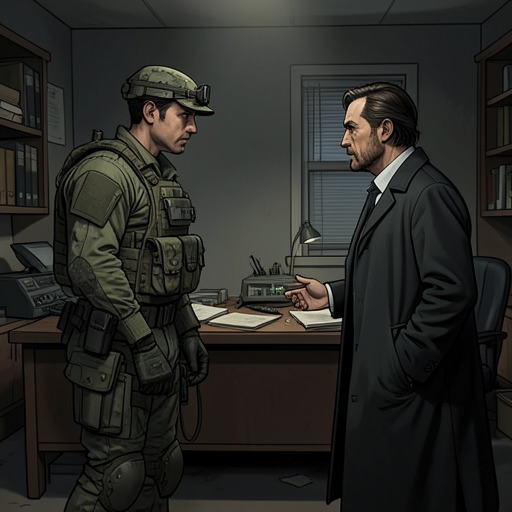
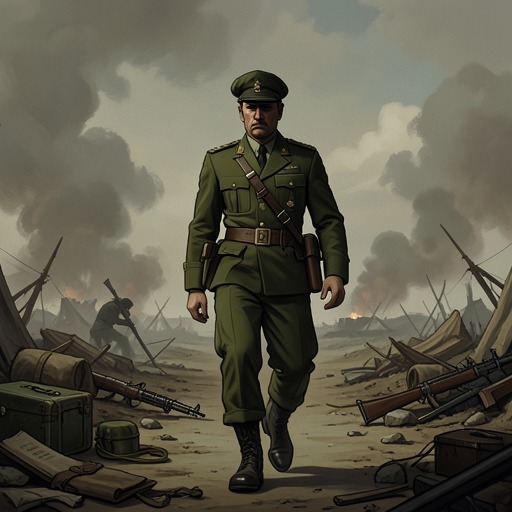
Across the River and into the TreesTruth in war experience and war writing is a central tension in the Colonel’s conversations with Renata: he can explain combat in precise operational detail, yet doubts that a person who has been there can write about it convincingly. His refusal to write does not silence his experience. Instead, he tells Renata about battles, command decisions, and the limits of military accounts, making the act of narration itself a test of what can be known and shared about war.
Experience as Knowledge
The Colonel’s authority begins in the work of fighting, not in abstract doctrine. During a winter campaign on the Piave River, he recalls defending against repeated attacks, training his troops to shoot and to keep firing when the enemy appeared. After bombardments, he had to count quickly to determine how many shooters remained. He presents combat knowledge as practical and exacting: it depends on the changing condition of a unit and on decisions made under pressure, rather than on a clean account reconstructed afterward.
That experience also shapes his attitude toward the enemy. He says he killed men during the winter but did not hate them. In conversation, he links his capacity for kindness to the number he has killed, giving a count of 122 confirmed kills, with possible additional ones. The figure is not offered as a boast so much as a blunt measure of accumulated experience. Renata, whose father was killed and whose family villa on the Brenta River was burned, cannot share his tolerant view; she also recalls seeing a German officer shoot pigeons in Piazza San Marco. Their disagreement makes clear that experience does not produce a single, universal response to war. Personal loss and combat familiarity lead them toward different forms of judgment.
Explaining Operations
When Renata asks how an armored breakthrough is made, the Colonel describes a sequence rather than a heroic instant. The force first has to take a town controlling the main roads; other towns and villages then have to be secured to open the routes. Enemy counterattacks are hindered when fighter-bombers can strike divisions moving along the roads. His explanation identifies terrain, roads, air power, and the timing of operations as connected parts of a military action. He acknowledges that the account bores him, but Renata says she has not heard the process explained so clearly and wants to share what matters to him.
His account of the advance toward Paris similarly resists the idea that a famous city’s capture can be reduced to a single decisive battle. He recalls separating from Leclerc’s column at Clamart: Leclerc’s forces went toward Montrouge and the Porte d’Orleans, while his own column went to Bas Meudon and secured the bridge at the Porte de Saint Cloud. He says the force fought twelve times on the way from Rambouillet into the city, but considers only the actions at Toussus le Noble and Le Buc substantial fights; the rest, in his telling, were lesser actions along the way. He also notes that the French had entered Paris four days earlier, while the Supreme Headquarters of the Allied Expeditionary Forces had a larger plan to envelop the city. For him, Paris was an emotional experience as well as a military setting, and its symbolic importance complicated the account of who had taken it and how.
The Colonel’s other battle stories preserve details that a broad campaign narrative could smooth away. He recounts the Valhalla Express marking enemy positions with colored smoke before subsequent sections bombed them. He describes the prisoners taken afterward as deeply shaken, even as he characterizes the bombing as effective. The account joins a tactical result to its human consequence, while also exposing the distance between the language of military necessity and the condition of those subjected to it.
Command, Orders, and Consequences
For the Colonel, firsthand knowledge includes the burdens of command. He explains that orders from Corps set what had to be done, while the commander decided how to do it; orders might be issued by telephone, and carrying them out could mean pressing people he respected to attempt what seemed nearly impossible. The work also meant staying awake late and rising early. This description makes command less a position of uncomplicated authority than a chain of decisions made under constraints, with responsibility concentrated in people who may not have chosen the objective.
His account of a regiment destroyed in an attack makes that conflict concrete. The unit was to advance in a line of three, with nothing in reserve, through woods whose conditions were already known to be unfavorable. Its identifying patches had been removed even from the rear echelon, but the order to commit a regiment before the attack meant that the enemy would be likely to take a prisoner and learn who was involved. The Colonel names the order and the regiment’s destruction, yet resists a simple assignment of villainy: he says Walter Bedell Smith had made promises and explained how the operation would proceed, but was not the villain, and he defends the regiment’s commander as a man he respected. The account does not erase responsibility; it shows how orders, foreknowledge, and loyalty complicate the telling of blame.
He also recalls losing a regiment after being ordered to take a position by assault. In his explanation, a phone call relayed an order from higher command, potentially passed down through several levels and prompted by a town’s appearance in the newspapers. He believes the opposing force consisted of professionals who might have negotiated if approached with a flag, and contrasts that possibility with the order to attack. The episode connects his account of military procedure to its consequences: the decision to assault a position could override a commander’s judgment about what the enemy might do, and the regiment he had hoped to command was lost under orders.
Why He Distrusts War Writing
Renata urges the Colonel to write so that others might know what war is like. He refuses, saying that he lacks the talent and knows too much. In his view, men who retain the first impressions of a short experience of battle may write worthwhile books, though those books can feel dull to someone who has been there. He is more severe toward writers who seek quick profit from wars they did not fight, professional writers whose other work kept them from combat, and a naval captain who wrote about the intimate dimensions of the larger war without being able to command a small boat. These are the Colonel’s judgments, not a neutral taxonomy of all war literature; they express his suspicion that vivid certainty can be manufactured without the knowledge it claims to represent.
His skepticism extends to generals’ memoirs. He tells Renata that, after a man becomes a general officer, truth can become difficult to reach, while captains may know the exact facts and often be able to tell them. The point is not simply that rank makes someone dishonest. The Colonel associates senior command with distance from events and with institutional pressures that can obscure what happened. His own preference for concrete routes, timings, troop conditions, and orders stands against accounts that turn a complicated operation into a polished retrospective explanation.
Telling Without Writing
Although the Colonel rejects the role of author, he does tell Renata about war. When she asks him to make his account more engaging, he says he can insert anecdotes to make it interesting or plausible. His distinction suggests an uneasy awareness that facts alone do not make a story easy to receive: narration involves selection and arrangement, but those choices can also risk making events seem more coherent than they were. The technical detail he supplies—towns, bridges, roads, units, and orders—becomes the evidence through which Renata can approach a life she did not experience.
The form of their exchange sharpens the paradox. Renata says that she loves him and wants to share his trade; he answers that nobody shares it with anybody, even as he continues explaining it. He will not promise a book, but he gives her accounts of the Piave River, Paris, and the destruction of a regiment, including details that resist celebratory or simplified versions of war. His refusal therefore marks a limit, not an absence of testimony. The conversations preserve the strain between the need to make experience intelligible and the Colonel’s fear that writing can turn lived events into an unearned or misleading certainty.